poem: On the Countess Dowager of Pembroke
Underneath this sable herse
Lies the subject of all verse:
Sidney's sister, Pembroke's mother:
Death, ere thou hast slain another,
Fair and learn'd, and good as she,
Time shall throw a dart at thee.
Marble piles let no man raise
To her name: for after days
Some kind woman born as she,
Reading this, like Niobe
Shall turn marble, and become
Both her mourner and her tomb.poem by William Browne
On the Countess Dowager of Pembroke - William Browne
Friday, February 6, 2009

The Charm - William Browne
poem: The Charm
Son of Erebus and Night,
Hie away; and aim thy flight
Where consort none other fowl
Than the bat and sullen owl;
Where upon the limber grass
Poppy and mandragoras
With like simples not a few
Hang for ever drops of dew.
Where flows Lethe without coil
Softly like a stream of oil.
Hie thee thither, gentle Sleep:
With this Greek no longer keep.
Thrice I charge thee by my wand;
Thrice with moly from my hand
Do I touch Ulysses' eyes,
And with the jaspis: Then arise,
Sagest Greek....poem by William Browne
Autumn - William browne

poem: Autumn
Autumn it was when droop'd the sweetest flow'rs,
And rivers, swoll'n with pride, o'erlook'd the banks;
Poor grew the day of summer's golden hours,
And void of sap stood Ida's cedar-ranks.
The pleasant meadows sadly lay
In chill and cooling sweats
By rising fountains, or as they
Fear'd winter's wastfull threats.poem by William Browne
Spring Morning II - William Browne
poem: Spring Morning II
Willie.
Roget, droop not, see the spring
Is the earth enamelling,
And the birds on every tree
Greet this morn with melody:
Hark, how yonder thrustle chants it,
And her mate as proudly vants it
See how every stream is dress'd
By her margin with the best
Of Flora's gifts; she seems glad
For such brooks such flow'rs she had.
All the trees are quaintly tired
With green buds, of all desired;
And the hawthorn every day
Spreads some little show of May:
See the primrose sweetly set
By the much-lov'd violet,
All the banks do sweetly cover,
As they would invite a lover
With his lass to see their dressing
And to grace them by their pressing:
Yet in all this merry tide
When all cares are laid aside,
Roget sits as if his blood
Had not felt the quick'ning good
Of the sun, nor cares to play,
Or with songs to pass the day
As he wont: fie, Roget, fie,
Raise thy head, and merrily
Tune us somewhat to thy reed:
See our flocks do freely feed,
Here we may together sit,
And for music very fit
Is this place; from yonder wood
Comes an echo shrill and good,
Twice full perfectly it will
Answer to thine oaten quill.
Roget, droop not then, but sing
Some kind welcome to the spring.poem by William Browne
Spring Morning - William Browne
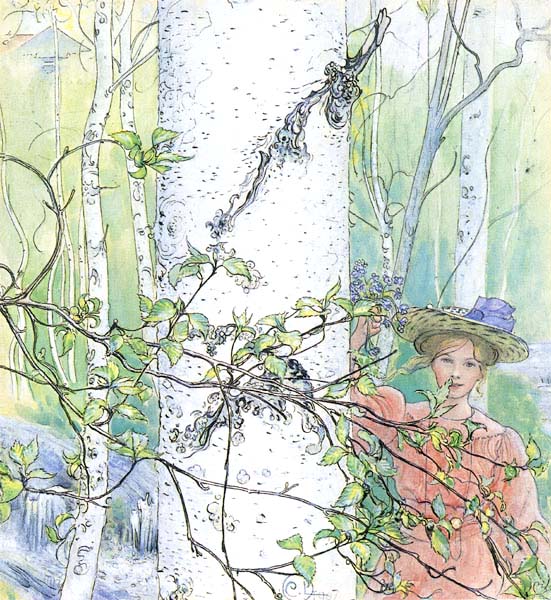
poem: Spring Morning I
Thomalin.
Where is every piping lad
That the fields are not yclad
With their milk-white sheep?
Tell me: is it holiday,
Or if in the month of May
Use they long to sleep?
Piers.
Thomalin, 'tis not too late,
For the turtle and her mate
Sitten yet in nest:
And the thrustle hath not been
Gath'ring worms yet on the green,
But attends her rest.
Not a bird hath taught her young,
Nor her morning's lesson sung
In the shady grove:
But the nightingale in dark
Singing woke the mounting lark:
She records her love.
Not the sun hath with his beams
Gilded yet our crystal streams;
Rising from the sea,
Mists do crown the mountains' tops,
And each pretty myrtle drops:
'Tis but newly day.poem by William Browne
A Song - William Browne

poem: A Song
Gentle nymphs, be not refusing,
Love's neglect is time's abusing,
They and beauty are but lent you;
Take the one and keep the other;
Love keeps fresh what age doth smother;
Beauty gone you will repent you.
'Twill be said when ye have proved,
Never swains more truly loved:
Oh then fly all nice behaviour!
Pity fain would (as her duty)
Be attending still on Beauty,
Let her not be out of favour.poem by William Browne
"Glide soft", ye Silver Floods" - William Browne
poem: "Glide soft", ye Silver Floods"
Glide soft, ye silver floods,
And every spring:
Within the shady woods
Let no bird sing!
Nor from the grove a turtle-dove
Be seen to couple with her love;
But silence on each dale and mountain dwell,
Whilst Willy bids his friend and joy farewell.
But (of great Thetis' train)
Ye mermaids fair,
That on the shores do plain
Your sea-green hair,
As ye in trammels knit your locks,
Weep ye; and so enforce the rocks
In heavy murmurs through the broad shores tell
How Willy bade his friend and joy farewell.
Cease, cease, ye murd'ring winds,
To move a wave;
But if with troubled minds
You seek his grave;
Know 'tis as various as yourselves,
Now in the deep, then on the shelves,
His coffin toss'd by fish and surges fell,
Whilst Willy weeps and bids all joy farewell.
Had he Arion-like
Been judged to drown,
He on his lute could strike
So rare a sowne,
A thousand dolphins would have come
And jointly strive to bring him home.
But he on shipboard died, by sickness fell,
Since when his Willy bade all joy farewell.
Great Neptune, hear a swain!
His coffin take,
And with a golden chain
For pity make
It fast unto a rock near land!
Where ev'ry calmy morn I'll stand,
And ere one sheep out of my fold I tell,
Sad Willy's pipe shall bid his friend farewell.poem by William Browne
A Rill - William Browne
poem: A Rill
So when the pretty rill a place espies,
Where with the pebbles she would wantonize,
And that her upper stream so much doth wrong her
To drive her thence, and let her play no longer;
If she with too loud mutt'ring ran away,
As being much incens'd to leave her play,
A western, mild and pretty whispering gale
Came dallying with the leaves along the dale,
And seem'd as with the water it did chide,
Because it ran so long unpacified:
Yea, and methought it bade her leave that coil,
Or he would choke her up with leaves and soil:
Whereat the riv'let in my mind did weep,
And hurl'd her head into a silent deep.poem by William Browne
An Angler - William Browne
poem: An Angler
Now as an angler melancholy standing
Upon a green bank yielding room for landing,
A wriggling yellow worm thrust on his hook,
Now in the midst he throws, then in a nook:
Here pulls his line, there throws it in again,
Mendeth his cork and bait, but all in vain,
He long stands viewing of the curled stream;
At last a hungry pike, or well-grown bream
Snatch at the worm, and hasting fast away,
He knowing it a fish of stubborn sway,
Pulls up his rod, but soft, as having skill,
Wherewith the hook fast holds the fish's gill;
Then all his line he freely yieldeth him,
Whilst furiously all up and down doth swim
Th' insnared fish, here on the top doth scud,
There underneath the banks, then in the mud,
And with his frantic fits so scares the shoal,
That each one takes his hide, or starting hole:
By this the pike, clean wearied, underneath
A willow lies.poem by William Browne
A Pleasant Grove - William Browne
poem: A Pleasant Grove
Unto a pleasant grove or such like place,
Where here the curious cutting of a hedge:
There, by a pond, the trimming of the sedge:
Here the fine setting of well-shading trees:
The walks there mounting up by small degrees,
The gravel and the green so equal lie,
It, with the rest, draws on your ling'ring eye:
Here the sweet smells that do perfume the air,
Arising from the infinite repair
Of odoriferous buds and herbs of price,
(As if it were another Paradise)
So please the smelling sense, that you are fain
Where last you walk'd to turn and walk again.
There the small birds with their harmonious notes
Sing to a spring that smileth as she floats:
For in her face a many dimples show,
And often skips as it did dancing go:
Here further down an over-arched alley,
That from a hill goes winding in a valley,
You spy at end thereof a standing lake,
Where some ingenious artist strives to make
The water (brought in turning pipes of lead
Through birds of earth most lively fashioned)
To counterfeit and mock the sylvans all,
In singing well their own set madrigal.
This with no small delight retains your ear,
And makes you think none blest but who live there.
Then in another place the fruits that be
In gallant clusters decking each good tree,
Invite your hand to crop some from the stem,
And liking one, taste every sort of them:
Then to the arbours walk, then to the bowers,
Thence to the walks again, thence to the flowers,
Then to birds, and to the clear spring thence,
Now pleasing one, and then another sense.
Here one walks oft, and yet anew begin'th,
As if it were some hidden labyrinth;
So loath to part and so content to stay,
That when the gard'ner knocks for you away,
It grieves you so to leave the pleasures in it,
That you could wish that you had never seen it.poem by William Browne
Night - William Browne

poem: Night
Now great Hyperion left his golden throne
That on the dancing waves in glory shone,
For whose declining on the western shore
The oriental hills black mantles wore,
And thence apace the gentle twilight fled,
That had from hideous caverns ushered
All-drowsy Night, who in a car of jet,
By steeds of iron-grey, which mainly sweat
Moist drops on all the world, drawn through the sky,
The helps of darkness waited orderly.
First thick clouds rose from all the liquid plains;
Then mists from marishes, and grounds whose veins
Were conduit-pipes to many a crystal spring;
From standing pools and fens were following
Unhealthy fogs; each river, every rill
Sent up their vapours to attend her will
These pitchy curtains drew 'twixt earth and heaven
And as Night's chariot through the air was driven,
Clamour grew dumb, unheard was shepherd's song
And silence girt the woods; no warbling tongue
Talk'd to the Echo; satyrs broke their dance,
And all the upper world lay in a trance.
Only the curled streams soft chidings kept;
And little gales that from the green leaf swept
Dry summer's dust, in fearful whisp'rings stirred.
As loath to waken any singing bird.poem by William Browne
Morning - William Browne

poem: Morning
The Muses' friend (grey-eyed Aurora) yet
Held all the meadows in a cooling sweat,
The milk-white gossamers not upwards snow'd,
Nor was the sharp and useful-steering goad
Laid on the strong-neck'd ox; no gentle bud
The sun had dried; the cattle chew'd the cud
Low levell'd on the grass; no fly's quick sting
Enforc'd the stonehorse in a furious ring
To tear the passive earth, nor lash his tail
About his buttocks broad; the slimy snail
Might on the wainscot, by his many mazes,
Winding meanders and self-knitting traces,
Be follow'd where he stuck, his glittering slime
Not yet wip'd off. It was so early time,
The careful smith had in his sooty forge
Kindled no coal; nor did his hammers urge
His neighbours' patience: owls abroad did fly,
And day as then might plead his in fancy.poem by William Browne
Flowers - William Browne

poem: Flowers
The daisy scatter'd on each mead and down,
A golden tuft within a silver crown;
(Fair fall that dainty flower! and may there be
No shepherd grac'd that doth not honour thee!)
The primrose, when with six leaves gotten grace
Maids as a true-love in their bosoms place;
The spotless lily, by whose pure leaves be
Noted the chaste thoughts of virginity;
Carnations sweet with colour like the fire,
The fit impresas for inflam'd desire;
The harebell for her stainless azur'd hue
Claims to be worn of none but those are true;
The rose, like ready youth, enticing stands,
And would be cropp'd if it might choose the hands,
The yellow kingcup Flora them assign'd
To be the badges of a jealous mind;
The orange-tawny marigold: the night
Hides not her colour from a searching sight....
The columbine in tawny often taken,
Is then ascrib'd to such as are forsaken;
Flora's choice buttons of a russet dye
Is hope even in the depth of misery.poem by William Browne
May Day Customs - William Browne
poem: May Day Customs
I have seen the Lady of the May
Set in an arbour, on a holiday,
Built by the May-pole, where the jocund swains
Dance with the maidens to the bagpipe's strains,
When envious night commands them to be gone
Call for the merry youngsters one by one,
And for their well performance soon disposes:
To this a garland interwove with roses,
To that a carvèd hook or well-wrought scrip,
Gracing another with her cherry lip;
To one her garter, to another then
A handkerchief cast o'er and o'er again;
And none returneth empty that hath spent
His pains to fill their rural merriment.poem by William Browne
A Concert of Birds - William Browne
poem: A Concert of Birds
The mounting lark (day's herald) got on wing,
Bidding each bird choose out his bough and sing.
The lofty treble sung the little wren;
Robin the mean, that best of all loves men;
The nightingale the tenor, and the thrush
The counter-tenor sweetly in a bush.
And that the music might be full in parts,
Birds from the groves flew with right willing hearts;
But (as it seem'd) they thought (as do the swains,
Which tune their pipes on sack'd Hibernia's plains)
There should some droning part be, therefore will'd
Some bird to fly into a neighb'ring field,
In embassy unto the King of Bees,
To aid his partners on the flowers and trees
Who, condescending, gladly flew along
To bear the bass to his well-tuned song.
The crow was willing they should be beholding
For his deep voice, but being hoarse with scolding,
He thus lends aid; upon an oak doth climb,
And nodding with his head, so keepeth time.poem by William Browne
Music on the Thames - William Browne
poem: Music on the Thames
As I have seen when on the breast of Thames
A heavenly bevy of sweet English dames,
In some calm ev'ning of delightful May,
With music give a farewell to the day,
Or as they would, with an admired tone,
Greet Night's ascension to her ebon throne,
Rapt with their melody a thousand more
Run to be wafted from the bounding shore.
As I have seen when on the breast of Thames
A heavenly bevy of sweet English dames,
In some calm ev'ning of delightful May,
With music give a farewell to the day,
Or as they would, with an admired tone,
Greet Night's ascension to her ebon throne,
Rapt with their melody a thousand more
Run to be wafted from the bounding shore.
poem by William Browne
Birds in May - William Browne

poem: Birds in May
As (woo'd by May's delights) I have been borne
To take the kind air of a wistful morn
Near Tavy's voiceful stream (to whom I owe
More strains than from my pipe can ever flow),
Here have I heard a sweet bird never lin
To chide the river for his clam'rous din;
There seem'd another in his song to tell,
That what the fair stream did he liked well
And going further heard another too,
All varying still in what the others do
A little thence, a fourth with little pain
Conn'd all their lessons, and them sung again;
So numberless the songsters are that sing
In the sweet groves of the too-careless spring,
That I no sooner could the hearing lose
Of one of them, but straight another rose
And perching deftly on a quaking spray,
Nigh tir'd herself to make her hearer stay.
. . . . .
Shrill as a thrush upon a morn of May.poem by William Browne
The Seasons - William Browne

poem: The Seasons
The year hath first his jocund spring,
Wherein the leaves, to birds' sweet carolling,
Dance with the wind; then sees the summer's day
Perfect the embryon blossom of each spray;
Next cometh autumn, when the threshèd sheaf
Loseth his grain, and every tree his leaf;
Lastly, cold winter's rage, with many a storm,
Threats the proud pines which Ida's top adorn,
And makes the sap leave succourless the shoot,
Shrinking to comfort his decaying root.poem by William Browne
"Venus by Adonis' Side" - William Browne
poem:"Venus by Adonis' Side"
Venus by Adonis' side
Crying kiss'd, and kissing cried,
Wrung her hands and tore her hair
For Adonis dying there.
Stay (quoth she) O stay and live!
Nature surely doth not give
To the earth her sweetest flowers
To be seen but some few hours.
On his face, still as he bled
For each drop a tear she shed,
Which she kiss'd or wip'd away,
Else had drown'd him where he lay.
Fair Proserpina (quoth she)
Shall not have thee yet from me;
Nor my soul to fly begin
While my lips can keep it in.
Here she clos'd again. And some
Say Apollo would have come
To have cur'd his wounded limb,
But that she had smothered him.poem by William Browne
To England - William Browne
poem: To England
Hail, thou my native soil! thou blessed plot
Whose equal all the world affordeth not!
Show me who can so many crystal rills,
Such sweet-clothed valleys or aspiring hills;
Such wood-ground, pastures, quarries, wealthy mines;
Such rocks in whom the diamond fairly shines;
And if the earth can show the like again,
Yet will she fail in her sea-ruling men.poem by William Browne
Subscribe to:
Posts (Atom)