Powered by Blogger.

Dedication by Lewis Carroll

Wednesday, January 14, 2009

Dedication
Inscribed to a Dear Child:
In Memory of Golden Summer Hours
And Whispers of a Summer Sea


Girt with a boyish garb for boyish task,
Eager she wields her spade: yet loves as well
Rest on a friendly knee, intent to ask
The tale he loves to tell.
Rude spirits of the seething outer strife,
Unmeet to read her pure and simple spright,
Deem if you list, such hours a waste of life,
Empty of all delight!

Chat on, sweet Maid, and rescue from annoy
Hearts that by wiser talk are unbeguiled.
Ah, happy he who owns that tenderest joy,
The heart-love of a child!

poem by Lewis Carroll

Size and Tears by Lewis Carroll

Size and Tears
When on the sandy shore I sit,
Beside the salt sea-wave,
And fall into a weeping fit
Because I dare not shave -
A little whisper at my ear
Enquires the reason of my fear.

I answer "If that ruffian Jones
Should recognise me here,
He'd bellow out my name in tones
Offensive to the ear:
He chaffs me so on being stout
(A thing that always puts me out)."

Ah me! I see him on the cliff!
Farewell, farewell to hope,
If he should look this way, and if
He's got his telescope!
To whatsoever place I flee,
My odious rival follows me!

For every night, and everywhere,
I meet him out at dinner;
And when I've found some charming fair,
And vowed to die or win her,
The wretch (he's thin and I am stout)
Is sure to come and cut me out!

The girls (just like them!) all agree
To praise J. Jones, Esquire:
I ask them what on earth they see
About him to admire?
They cry "He is so sleek and slim,
It's quite a treat to look at him!"

They vanish in tobacco smoke,
Those visionary maids -
I feel a sharp and sudden poke
Between the shoulder-blades -
"Why, Brown, my boy! Your growing stout!"
(I told you he would find me out!)

"My growth is not YOUR business, Sir!"
"No more it is, my boy!
But if it's YOURS, as I infer,
Why, Brown, I give you joy!
A man, whose business prospers so,
Is just the sort of man to know!

"It's hardly safe, though, talking here -
I'd best get out of reach:
For such a weight as yours, I fear,
Must shortly sink the beach!" -
Insult me thus because I'm stout!
I vow I'll go and call him out!

poem by Lewis Carroll

Echoes by Lewis Carroll

Echoes
Lady Clara Vere de Vere
Was eight years old, she said:
Every ringlet, lightly shaken, ran itself in golden thread.

She took her little porringer:
Of me she shall not win renown:
For the baseness of its nature shall have strength to drag her
down.

"Sisters and brothers, little Maid?
There stands the Inspector at thy door:
Like a dog, he hunts for boys who know not two and two are four."

"Kind words are more than coronets,"
She said, and wondering looked at me:
"It is the dead unhappy night, and I must hurry home to tea."

poem by Lewis Carroll

A Nursery Darling by Lewis Carroll

three ages of woman
A Nursery Darling
A Mother's breast:
Safe refuge from her childish fears,
From childish troubles, childish tears,
Mists that enshroud her dawning years!
see how in sleep she seems to sing
A voiceless psalm--an offering
Raised, to the glory of her King
In Love: for Love is Rest.


A Darling's kiss:
Dearest of all the signs that fleet
From lips that lovingly repeat
Again, again, the message sweet!
Full to the brim with girlish glee,
A child, a very child is she,
Whose dream of heaven is still to be
At Home: for Home is Bliss.

poem by Lewis Carroll

Photography Extraordinary by Lewis Carroll

Photography Extraordinary
The Milk-and-Water School
Alas! she would not hear my prayer!
Yet it were rash to tear my hair;
Disfigured, I should be less fair.

She was unwise, I may say blind;
Once she was lovingly inclined;
Some circumstance has changed her mind.


The Strong-Minded or Matter-of-Fact School
Well! so my offer was no go!
She might do worse, I told her so;
She was a fool to answer "No".

However, things are as they stood;
Nor would I have her if I could,
For there are plenty more as good.


The Spasmodic or German School
Firebrands and Daggers! hope hath fled!
To atoms dash the doubly dead!
My brain is fire--my heart is lead!

Her soul is flint, and what am I?
Scorch'd by her fierce, relentless eye,
Nothingness is my destiny!

poem by Lewis Carroll

The Lobster Quadrille by Lewis Carroll

The Lobster Quadrille
"Will you walk a little faster?" said a whiting to a snail,
"There's a porpoise close behind us, and he's treading on my tail.
See how eagerly the lobsters and the turtles all advance!
They are waiting on the shingle--will you come and join the dance?
Will you, won't you, will you, won't you, will you join the dance?
Will you, won't you, will you, won' t you, won' t you join the dance?

"You can really have no notion how delightful it will be
When they take us up and throw us, with the lobsters, out to sea!"
But the snail replied, "Too far, too far!" and gave a look askance--
Said he thanked the whiting kindly, but he would not join the dance.
Would not, could not, would not, could not, would not join the dance.
Would not, could not, would not, could not, could not join the dance.

"What matters it how far we go?" his scaly friend replied.
"There is another shore, you know, upon the other side.
The further off from England the nearer is to France--
Then turn not pale, beloved snail, but come and join the dance.
Will you, won't you, will you, won't you, won't you join the dance?
Will you, won' t you, will you, won't you, won't you join the dance ?"

poem by Lewis Carroll

The Mad Gardener's Song by Lewis Carroll

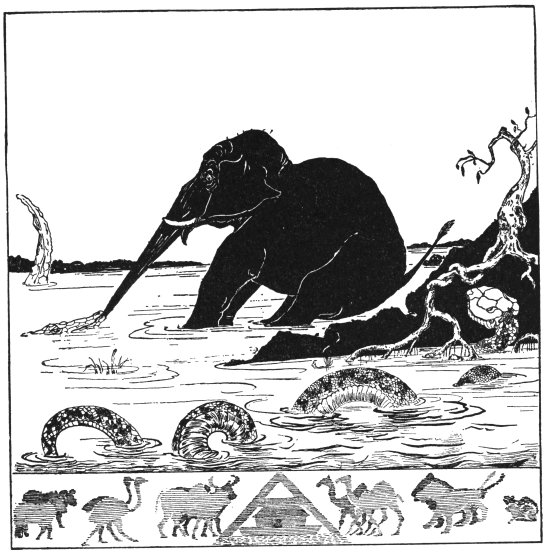
the elephant
The Mad Gardener's Song
He thought he saw an Elephant,
That practised on a fife:
He looked again, and found it was
A letter from his wife.
'At length I realise,' he said,
The bitterness of Life!'

He thought he saw a Buffalo
Upon the chimney-piece:
He looked again, and found it was
His Sister's Husband's Niece.
'Unless you leave this house,' he said,
"I'll send for the Police!'

He thought he saw a Rattlesnake
That questioned him in Greek:
He looked again, and found it was
The Middle of Next Week.
'The one thing I regret,' he said,
'Is that it cannot speak!'

He thought he saw a Banker's Clerk
Descending from the bus:
He looked again, and found it was
A Hippopotamus.
'If this should stay to dine,' he said,
'There won't be much for us!'

He thought he saw a Kangaroo
That worked a coffee-mill:
He looked again, and found it was
A Vegetable-Pill.
'Were I to swallow this,' he said,
'I should be very ill!'

He thought he saw a Coach-and-Four
That stood beside his bed:
He looked again, and found it was
A Bear without a Head.
'Poor thing,' he said, 'poor silly thing!
It's waiting to be fed!'

He thought he saw an Albatross
That fluttered round the lamp:
He looked again, and found it was
A Penny-Postage Stamp.
'You'd best be getting home,' he said:
'The nights are very damp!'

He thought he saw a Garden-Door
That opened with a key:
He looked again, and found it was
A Double Rule of Three:
'And all its mystery,' he said,
'Is clear as day to me!'

He thought he saw a Argument
That proved he was the Pope:
He looked again, and found it was
A Bar of Mottled Soap.
'A fact so dread,' he faintly said,
'Extinguishes all hope!'

poem by Lewis Carroll

The Three Voices by Lewis Carroll

The Three Voices
The First Voice


HE trilled a carol fresh and free,
He laughed aloud for very glee:
There came a breeze from off the sea:

It passed athwart the glooming flat -
It fanned his forehead as he sat -
It lightly bore away his hat,

All to the feet of one who stood
Like maid enchanted in a wood,
Frowning as darkly as she could.

With huge umbrella, lank and brown,
Unerringly she pinned it down,
Right through the centre of the crown.

Then, with an aspect cold and grim,
Regardless of its battered rim,
She took it up and gave it him.

A while like one in dreams he stood,
Then faltered forth his gratitude
In words just short of being rude:

For it had lost its shape and shine,
And it had cost him four-and-nine,
And he was going out to dine.

"To dine!" she sneered in acid tone.
"To bend thy being to a bone
Clothed in a radiance not its own!"

The tear-drop trickled to his chin:
There was a meaning in her grin
That made him feel on fire within.

"Term it not 'radiance,'" said he:
"'Tis solid nutriment to me.
Dinner is Dinner: Tea is Tea."

And she "Yea so? Yet wherefore cease?
Let thy scant knowledge find increase.
Say 'Men are Men, and Geese are Geese.'"

He moaned: he knew not what to say.
The thought "That I could get away!"
Strove with the thought "But I must stay.

"To dine!" she shrieked in dragon-wrath.
"To swallow wines all foam and froth!
To simper at a table-cloth!

"Say, can thy noble spirit stoop
To join the gormandising troup
Who find a solace in the soup?

"Canst thou desire or pie or puff?
Thy well-bred manners were enough,
Without such gross material stuff."

"Yet well-bred men," he faintly said,
"Are not willing to be fed:
Nor are they well without the bread."

Her visage scorched him ere she spoke:
"There are," she said, "a kind of folk
Who have no horror of a joke.

"Such wretches live: they take their share
Of common earth and common air:
We come across them here and there:

"We grant them - there is no escape -
A sort of semi-human shape
Suggestive of the man-like Ape."

"In all such theories," said he,
"One fixed exception there must be.
That is, the Present Company."

Baffled, she gave a wolfish bark:
He, aiming blindly in the dark,
With random shaft had pierced the mark.

She felt that her defeat was plain,
Yet madly strove with might and main
To get the upper hand again.

Fixing her eyes upon the beach,
As though unconscious of his speech,
She said "Each gives to more than each."

He could not answer yea or nay:
He faltered "Gifts may pass away."
Yet knew not what he meant to say.

"If that be so," she straight replied,
"Each heart with each doth coincide.
What boots it? For the world is wide."

"The world is but a Thought," said he:
"The vast unfathomable sea
Is but a Notion - unto me."

And darkly fell her answer dread
Upon his unresisting head,
Like half a hundredweight of lead.

"The Good and Great must ever shun
That reckless and abandoned one
Who stoops to perpetrate a pun.

"The man that smokes - that reads the TIMES -
That goes to Christmas Pantomimes -
Is capable of ANY crimes!"

He felt it was his turn to speak,
And, with a shamed and crimson cheek,
Moaned "This is harder than Bezique!"

But when she asked him "Wherefore so?"
He felt his very whiskers glow,
And frankly owned "I do not know."

While, like broad waves of golden grain,
Or sunlit hues on cloistered pane,
His colour came and went again.

Pitying his obvious distress,
Yet with a tinge of bitterness,
She said "The More exceeds the Less."

"A truth of such undoubted weight,"
He urged, "and so extreme in date,
It were superfluous to state."

Roused into sudden passion, she
In tone of cold malignity:
"To others, yea: but not to thee."

But when she saw him quail and quake,
And when he urged "For pity's sake!"
Once more in gentle tones she spake.

"Thought in the mind doth still abide
That is by Intellect supplied,
And within that Idea doth hide:

"And he, that yearns the truth to know,
Still further inwardly may go,
And find Idea from Notion flow:

"And thus the chain, that sages sought,
Is to a glorious circle wrought,
For Notion hath its source in Thought."

So passed they on with even pace:
Yet gradually one might trace
A shadow growing on his face.


The Second Voice


THEY walked beside the wave-worn beach;
Her tongue was very apt to teach,
And now and then he did beseech

She would abate her dulcet tone,
Because the talk was all her own,
And he was dull as any drone.

She urged "No cheese is made of chalk":
And ceaseless flowed her dreary talk,
Tuned to the footfall of a walk.

Her voice was very full and rich,
And, when at length she asked him "Which?"
It mounted to its highest pitch.

He a bewildered answer gave,
Drowned in the sullen moaning wave,
Lost in the echoes of the cave.

He answered her he knew not what:
Like shaft from bow at random shot,
He spoke, but she regarded not.

She waited not for his reply,
But with a downward leaden eye
Went on as if he were not by

Sound argument and grave defence,
Strange questions raised on "Why?" and "Whence?"
And wildly tangled evidence.

When he, with racked and whirling brain,
Feebly implored her to explain,
She simply said it all again.

Wrenched with an agony intense,
He spake, neglecting Sound and Sense,
And careless of all consequence:

"Mind - I believe - is Essence - Ent -
Abstract - that is - an Accident -
Which we - that is to say - I meant - "

When, with quick breath and cheeks all flushed,
At length his speech was somewhat hushed,
She looked at him, and he was crushed.

It needed not her calm reply:
She fixed him with a stony eye,
And he could neither fight nor fly.

While she dissected, word by word,
His speech, half guessed at and half heard,
As might a cat a little bird.

Then, having wholly overthrown
His views, and stripped them to the bone,
Proceeded to unfold her own.

"Shall Man be Man? And shall he miss
Of other thoughts no thought but this,
Harmonious dews of sober bliss?

"What boots it? Shall his fevered eye
Through towering nothingness descry
The grisly phantom hurry by?

"And hear dumb shrieks that fill the air;
See mouths that gape, and eyes that stare
And redden in the dusky glare?

"The meadows breathing amber light,
The darkness toppling from the height,
The feathery train of granite Night?

"Shall he, grown gray among his peers,
Through the thick curtain of his tears
Catch glimpses of his earlier years,

"And hear the sounds he knew of yore,
Old shufflings on the sanded floor,
Old knuckles tapping at the door?

"Yet still before him as he flies
One pallid form shall ever rise,
And, bodying forth in glassy eyes

"The vision of a vanished good,
Low peering through the tangled wood,
Shall freeze the current of his blood."

Still from each fact, with skill uncouth
And savage rapture, like a tooth
She wrenched some slow reluctant truth.

Till, like a silent water-mill,
When summer suns have dried the rill,
She reached a full stop, and was still.

Dead calm succeeded to the fuss,
As when the loaded omnibus
Has reached the railway terminus:

When, for the tumult of the street,
Is heard the engine's stifled beat,
The velvet tread of porters' feet.

With glance that ever sought the ground,
She moved her lips without a sound,
And every now and then she frowned.

He gazed upon the sleeping sea,
And joyed in its tranquillity,
And in that silence dead, but she

To muse a little space did seem,
Then, like the echo of a dream,
Harked back upon her threadbare theme.

Still an attentive ear he lent
But could not fathom what she meant:
She was not deep, nor eloquent.

He marked the ripple on the sand:
The even swaying of her hand
Was all that he could understand.

He saw in dreams a drawing-room,
Where thirteen wretches sat in gloom,
Waiting - he thought he knew for whom:

He saw them drooping here and there,
Each feebly huddled on a chair,
In attitudes of blank despair:

Oysters were not more mute than they,
For all their brains were pumped away,
And they had nothing more to say -

Save one, who groaned "Three hours are gone!"
Who shrieked "We'll wait no longer, John!
Tell them to set the dinner on!"

The vision passed: the ghosts were fled:
He saw once more that woman dread:
He heard once more the words she said.

He left her, and he turned aside:
He sat and watched the coming tide
Across the shores so newly dried.

He wondered at the waters clear,
The breeze that whispered in his ear,
The billows heaving far and near,

And why he had so long preferred
To hang upon her every word:
"In truth," he said, "it was absurd."


The Third Voice


NOT long this transport held its place:
Within a little moment's space
Quick tears were raining down his face

His heart stood still, aghast with fear;
A wordless voice, nor far nor near,
He seemed to hear and not to hear.

"Tears kindle not the doubtful spark.
If so, why not? Of this remark
The bearings are profoundly dark."

"Her speech," he said, "hath caused this pain.
Easier I count it to explain
The jargon of the howling main,

"Or, stretched beside some babbling brook,
To con, with inexpressive look,
An unintelligible book."

Low spake the voice within his head,
In words imagined more than said,
Soundless as ghost's intended tread:

"If thou art duller than before,
Why quittedst thou the voice of lore?
Why not endure, expecting more?"

"Rather than that," he groaned aghast,
"I'd writhe in depths of cavern vast,
Some loathly vampire's rich repast."

"'Twere hard," it answered, "themes immense
To coop within the narrow fence
That rings THY scant intelligence."

"Not so," he urged, "nor once alone:
But there was something in her tone
That chilled me to the very bone.

"Her style was anything but clear,
And most unpleasantly severe;
Her epithets were very queer.

"And yet, so grand were her replies,
I could not choose but deem her wise;
I did not dare to criticise;

"Nor did I leave her, till she went
So deep in tangled argument
That all my powers of thought were spent."

A little whisper inly slid,
"Yet truth is truth: you know you did."
A little wink beneath the lid.

And, sickened with excess of dread,
Prone to the dust he bent his head,
And lay like one three-quarters dead

The whisper left him - like a breeze
Lost in the depths of leafy trees -
Left him by no means at his ease.

Once more he weltered in despair,
With hands, through denser-matted hair,
More tightly clenched than then they were.

When, bathed in Dawn of living red,
Majestic frowned the mountain head,
"Tell me my fault," was all he said.

When, at high Noon, the blazing sky
Scorched in his head each haggard eye,
Then keenest rose his weary cry.

And when at Eve the unpitying sun
Smiled grimly on the solemn fun,
"Alack," he sighed, "what HAVE I done?"

But saddest, darkest was the sight,
When the cold grasp of leaden Night
Dashed him to earth, and held him tight.

Tortured, unaided, and alone,
Thunders were silence to his groan,
Bagpipes sweet music to its tone:

"What? Ever thus, in dismal round,
Shall Pain and Mystery profound
Pursue me like a sleepless hound,

"With crimson-dashed and eager jaws,
Me, still in ignorance of the cause,
Unknowing what I broke of laws?"

The whisper to his ear did seem
Like echoed flow of silent stream,
Or shadow of forgotten dream,

The whisper trembling in the wind:
"Her fate with thine was intertwined,"
So spake it in his inner mind:

"Each orbed on each a baleful star:
Each proved the other's blight and bar:
Each unto each were best, most far:

"Yea, each to each was worse than foe:
Thou, a scared dullard, gibbering low,
AND SHE, AN AVALANCHE OF WOE!"

poem by Lewis Carroll

Rules and Regulations by Lewis Carroll

Rules and Regulations
A short direction
To avoid dejection,
By variations
In occupations,
And prolongation
Of relaxation,
And combinations
Of recreations,
And disputation
On the state of the nation
In adaptation
To your station,
By invitations
To friends and relations,
By evitation
Of amputation,
By permutation
In conversation,
And deep reflection
You'll avoid dejection.

Learn well your grammar,
And never stammer,
Write well and neatly,
And sing most sweetly,
Be enterprising,
Love early rising,
Go walk of six miles,
Have ready quick smiles,
With lightsome laughter,
Soft flowing after.
Drink tea, not coffee;
Never eat toffy.
Eat bread with butter.
Once more, don't stutter.

Don't waste your money,
Abstain from honey.
Shut doors behind you,
(Don't slam them, mind you.)
Drink beer, not porter.
Don't enter the water
Till to swim you are able.
Sit close to the table.
Take care of a candle.
Shut a door by the handle,
Don't push with your shoulder
Until you are older.
Lose not a button.
Refuse cold mutton.
Starve your canaries.
Believe in fairies.
If you are able,
Don't have a stable
With any mangers.
Be rude to strangers.

Moral: Behave.

poem by Lewis Carroll

A Boat beneath a Sunny Sky by Lewis Carroll

A Boat beneath a Sunny Sky
A BOAT beneath a sunny sky,
Lingering onward dreamily
In an evening of July --
Children three that nestle near,
Eager eye and willing ear,
Pleased a simple tale to hear --
Long has paled that sunny sky:
Echoes fade and memories die:
Autumn frosts have slain July.
Still she haunts me, phantomwise,
Alice moving under skies
Never seen by waking eyes.
Children yet, the tale to hear,
Eager eye and willing ear,
Lovingly shall nestle near.
In a Wonderland they lie,
Dreaming as the days go by,
Dreaming as the summers die:
Ever drifting down the stream --
Lingering in the golden dream --
Life, what is it but a dream?

THE END

poem by Lewis Carroll

Why by Bliss Carman

Why
FOR a name unknown,
Whose fame unblown
Sleeps in the hills
For ever and aye;

For her who hears
The stir of the years
Go by on the wind
By night and day;

And heeds no thing
Of the needs of spring,
Of autumn's wonder
Or winter's chill;

For one who sees
The great sun freeze,
As he wanders a-cold
From hill to hill;

And all her heart
Is a woven part
Of the flurry and drift
Of whirling snow;

For the sake of two
Sad eyes and true,
And the old, old love
So long ago.

poem by Bliss Carman

Veni Creator by Bliss Carman

Veni Creator
I

LORD of the grass and hill,
Lord of the rain,
White Overlord of will,
Master of pain,

I who am dust and air
Blown through the halls of death,
Like a pale ghost of prayer,—
I am thy breath.

Lord of the blade and leaf,
Lord of the bloom,
Sheer Overlord of grief,
Master of doom,

Lonely as wind or snow,
Through the vague world and dim,
Vagrant and glad I go;
I am thy whim.

Lord of the storm and lull,
Lord of the sea,
I am thy broken gull,
Blown far alee.

Lord of the harvest dew,
Lord of the dawn,
Star of the paling blue
Darkling and gone,

Lost on the mountain height
Where the first winds are stirred,
Out of the wells of night
I am thy word.

Lord of the haunted hush,
Where raptures throng,
I am thy hermit thrush,
Ending no song.

Lord of the frost and cold,
Lord of the North,
When the red sun grows old
And day goes forth,

I shall put off this girth,—
Go glad and free,
Earth to my mother earth,
Spirit to thee.

II

Lord of my heart’s elation,
Spirit of things unseen,
Be thou my aspiration
Consuming and serene!

Bear up, bear out, bear onward
This mortal soul alone,
To selfhood or oblivion,
Incredibly thine own,—

As the foamheads are loosened
And blown along the sea,
Or sink and merge forever
In that which bids them be.

I, too, must climb in wonder,
Uplift at thy command,—
Be one with my frail fellows
Beneath the wind’s strong hand,

A fleet and shadowy column
Of dust or mountain rain,
To walk the earth a moment
And be dissolved again.

Be thou my exaltation
Or fortitude of mien,
Lord of the world’s elation
Thou breath of things unseen!

poem by Bliss Carman

The Vagabonds by Bliss Carman

The Vagabonds
We are the vagabonds of time,
And rove the yellow autumn days,
When all the roads are gray with rime
And all the valleys blue with haze.
We came unlooked for as the wind
Trooping across the April hills,
When the brown waking earth had dreams
Of summer in the Wander Kills.
How far afield we joyed to fare,
With June in every blade and tree!
Now with the sea-wind in our hair
We turn our faces to the sea.

We go unheeded as the stream
That wanders by the hill-wood side,
Till the great marshes take his hand
And lead him to the roving tide.

The roving tide, the sleeping hills,
These are the borders of that zone
Where they may fare as fancy wills
Whom wisdom smiles and calls her own.

It is a country of the sun,
Full of forgotten yesterdays,
When Time takes Summer in his care,
And fills the distance of her gaze.

It stretches from the open sea
To the blue mountains and beyond;
The world is Vagabondia
To him who is a vagabond.

In the beginning God made man
Out of the wandering dust, men say;
And in the end his life shall be
A wandering wind and blown away.

We are the vagabonds of time,
Willing to let the world go by,
With joy supreme, with heart sublime,
And valor in the kindling eye.

We have forgotten where we slept,
And guess not where we sleep to-night,
Whether among the lonely hills
In the pale streamers' ghostly light

We shall lie down and hear the frost
Walk in the dead leaves restlessly,
Or somewhere on the iron coast
Learn the oblivion of the sea.

It matters not. And yet I dream
Of dreams fulfilled and rest somewhere
Before this restless heart is stilled
And all its fancies blown to air.

Had I my will! . . . The sun burns down
And something plucks my garment's hem:
The robins in their faded brown
Would lure me to the south with them.

'Tis time for vagabonds to make
The nearest inn. Far on I hear
The voices of the Northern hills
Gather the vagrants of the year.

Brave heart, my soul! Let longings be!
We have another day to wend.
For dark or waylay what care we
Who have the lords of time to friend?

And if we tarry or make haste,
The wayside sleep can hold no fear.
Shall fate unpoise, or whim perturb,
The calm-begirt in dawn austere?

There is a tavern, I have heard,
Not far, and frugal, kept by One
Who knows the children of the Word,
And welcomes each when day is done.

Some say the house is lonely set
In Northern night, and snowdrifts keep
The silent door; the hearth is cold,
And all my fellows gone to sleep....

Had I my will! I hear the sea
Thunder a welcome on the shore;
I know where lies the hostelry
And who should open me the door.

poem by Bliss Carman

The Ships of Saint John by Bliss Carman

The Ships of Saint John
Where are the ships I used to know,
That came to port on the Fundy tide
Half a century ago,
In beauty and stately pride?
In they would come past the beacon light,
With the sun on gleaming sail and spar,
Folding their wings like birds in flight
From countries strange and far.
Schooner and brig and barkentine,
I watched them slow as the sails were furled,
And wondered what cities they must have seen
On the other side of the world.

Frenchman and Britisher and Dane,
Yankee, Spaniard and Portugee,
And many a home ship back again
With her stories of the sea.

Calm and victorious, at rest
From the relentless, rough sea-play,
The wild duck on the river's breast
Was not more sure than they.

The creatures of a passing race,
The dark spruce forests made them strong,
The sea's lore gave them magic grace,
The great winds taught them song.

And God endowed them each with life--
His blessing on the craftsman's skill--
To meet the blind unreasoned strife
And dare the risk of ill.

Not mere insensate wood and paint
Obedient to the helm's command,
But often restive as a saint
Beneath the Heavenly hand.

All the beauty and mystery
Of life were there, adventure bold,
Youth, and the glamour of the sea
And all its sorrows old.

And many a time I saw them go
Out on the flood at morning brave,
As the little tugs had them in tow,
And the sunlight danced on the wave.

There all day long you could hear the sound
Of the caulking iron, the ship's bronze bell,
And the clank of the capstan going round
As the great tides rose and fell.

The sailors' songs, the Captain's shout,
The boatswain's whistle piping shrill,
And the roar as the anchor chain runs out,--
I often hear them still.

I can see them still, the sun on their gear,
The shining streak as the hulls careen,
And the flag at the peak unfurling,--clear
As a picture on a screen.

The fog still hangs on the long tide-rips,
The gulls go wavering to and fro,
But where are all the beautiful ships
I knew so long ago?

poem by Bliss Carman

The Heart of Night by Bliss Carman

The Heart of Night
When all the stars are sown
Across the night-blue space,
With the immense unknown,
In silence face to face.
We stand in speechless awe
While Beauty marches by,
And wonder at the Law
Which wears such majesty.
How small a thing is man
In all that world-sown vast,
That he should hope or plan
Or dream his dream could last!

O doubter of the light,
Confused by fear and wrong,
Lean on the heart of night
And let love make thee strong!

The Good that is the True
Is clothed with Beauty still.
Lo, in their tent of blue,
The stars above the hill!

poem by Bliss Carman

Rivers of Canada by Bliss Carman

Rivers of Canada
O all the little rivers that run to Hudson's Bay,
They call me and call me to follow them away.
Missinaibi, Abitibi, Little Current--where they run
Dancing and sparkling I see them in the sun.
I hear the brawling rapid, the thunder of the fall,
And when I think upon them I cannot stay at all.
At the far end of the carry, where the wilderness begins,
Set me down with my canoe-load--and forgiveness of my sins.
O all the mighty rivers beneath the Polar Star,
They call me and call me to follow them afar.

Peace and Athabasca and Coppermine and Slave,
And Yukon and Mackenzie--the highroads of the brave.

Saskatchewan, Assiniboine, the Bow and the Qu'Appelle,
And many a prairie river whose name is like a spell.

They rumor through the twilight at the edge of the unknown,
"There's a message waiting for you, and a kingdom all your own.

"The wilderness shall feed you, her gleam shall be your guide.
Come out from desolations, our path of hope is wide."

O all the headlong rivers that hurry to the West,
They call me and lure me with the joy of their unrest.

Columbia and Fraser and Bear and Kootenay,
I love their fearless reaches where winds untarnished play--

The rush of glacial water across the pebbly bar
To polished pools of azure where the hidden boulders are.

Just there, with heaven smiling, any morning I would be,
Where all the silver rivers go racing to the sea.

O well remembered rivers that sing of long ago,
Ajourneying through summer or dreaming under snow.

Among their meadow islands through placid days they glide,
And where the peaceful orchards are diked against the tide.

Tobique and Madawaska and shining Gaspereaux,
St. Croix and Nashwaak and St. John whose haunts I used to know.

And all the pleasant rivers that seek the Fundy foam,
They call me and call me to follow them home.

poem by Bliss Carman

Low Tide on Grand Pré by Bliss Carman

Low Tide on Grand Pré
The sun goes down, and over all
These barren reaches by the tide
Such unelusive glories fall,
I almost dream they yet will bide
Until the coming of the tide.
And yet I know that not for us,
By any ecstasy of dream,
He lingers to keep luminous
A little while the grievous stream,
Which frets, uncomforted of dream--

A grievous stream, that to and fro
Athrough the fields of Acadie
Goes wandering, as if to know
Why one beloved face should be
So long from home and Acadie.

Was it a year or lives ago
We took the grasses in our hands,
And caught the summer flying low
Over the waving meadow lands,
And held it there between our hands?

The while the river at our feet--
A drowsy inland meadow stream--
At set of sun the after-heat
Made running gold, and in the gleam
We freed our birch upon the stream.

There down along the elms at dusk
We lifted dripping blade to drift,
Through twilight scented fine like musk,
Where night and gloom awhile uplift,
Nor sunder soul and soul adrift.

And that we took into our hands
Spirit of life or subtler thing--
Breathed on us there, and loosed the bands
Of death, and taught us, whispering,
The secret of some wonder-thing.

Then all your face grew light, and seemed
To hold the shadow of the sun;
The evening faltered, and I deemed
That time was ripe, and years had done
Their wheeling underneath the sun.

So all desire and all regret,
And fear and memory, were naught;
One to remember or forget
The keen delight our hands had caught;
Morrow and yesterday were naught.

The night has fallen, and the tide . . .
Now and again comes drifting home,
Across these aching barrens wide,
A sigh like driven wind or foam:
In grief the flood is bursting home.

poem by Bliss Carman

If Death be Good by Bliss Carman

If Death be Good
(Sappho LXXIV)
If death be good,
Why do the gods not die?
If life be ill,
Why do the gods still live?
If love be naught,
Why do the gods still love?
If love be all,
What should men do but love?

poem by Bliss Carman

Earth Voices by Bliss Carman

Earth Voices
I
I heard the spring wind whisper
Above the brushwood fire,
"The world is made forever
Of transport and desire.
"I am the breath of being,
The primal urge of things;
I am the whirl of star dust,
I am the lift of wings.
"I am the splendid impulse
That comes before the thought,
The joy and exaltation
Wherein the life is caught.

"Across the sleeping furrows
I call the buried seed,
And blade and bud and blossom
Awaken at my need.

"Within the dying ashes
I blow the sacred spark,
And make the hearts of lovers
To leap against the dark."II

I heard the spring light whisper
Above the dancing stream,
"The world is made forever
In likeness of a dream.

"I am the law of planets,
I am the guide of man;
The evening and the morning
Are fashioned to my plan.

"I tint the dawn with crimson,
I tinge the sea with blue;
My track is in the desert,
My trail is in the dew.

"I paint the hills with color,
And in my magic dome
I light the star of evening
To steer the traveller home.

"Within the house of being,
I feed the lamp of truth
With tales of ancient wisdom
And prophecies of youth."III

I heard the spring rain murmur
Above the roadside flower,
"The world is made forever
In melody and power.

"I keep the rhythmic measure
That marks the steps of time,
And all my toil is fashioned
To symmetry and rhyme.

"I plow the untilled upland,
I ripe the seeding grass,
And fill the leafy forest
With music as I pass.

"I hew the raw, rough granite
To loveliness of line,
And when my work is finished,
Behold, it is divine!

"I am the master-builder
In whom the ages trust.
I lift the lost perfection
To blossom from the dust."IV

Then Earth to them made answer,
As with a slow refrain
Born of the blended voices
Of wind and sun and rain,

"This is the law of being
That links the threefold chain:
The life we give to beauty
Returns to us again."

poem by Bliss Carman

Behind the Arras by Bliss Carman

Behind the Arras
I like the old house tolerably well,
Where I must dwell
Like a familiar gnome;
And yet I never shall feel quite at home.
I love to roam.
Day after day I loiter and explore
From door to door;
So many treasures lure
The curious mind. What histories obscure
They must immure!

I hardly know which room I care for best;
This fronting west,
With the strange hills in view,
Where the great sun goes,—where I may go too,
When my lease is through,—

Or this one for the morning and the east,
Where a man may feast
His eyes on looming sails,
And be the first to catch their foreign hails
Or spy their bales

Then the pale summer twilights towards the pole!
It thrills my soul
With wonder and delight,
When gold-green shadows walk the world at night,
So still, so bright.

There at the window many a time of year,
Strange faces peer,
Solemn though not unkind,
Their wits in search of something left behind
Time out of mind;

As if they once had lived here, and stole back
To the window crack
For a peep which seems to say,
"Good fortune, brother, in your house of clay!"
And then, "Good day!"

I hear their footsteps on the gravel walk,
Their scraps of talk,
And hurrying after, reach
Only the crazy sea-drone of the beach
In endless speech.

And often when the autumn noons are still,
By swale and hill
I see their gipsy signs,
Trespassing somewhere on my border lines;
With what designs?

I forth afoot; but when I reach the place,
Hardly a trace,
Save the soft purple haze
Of smouldering camp-fires, any hint betrays
Who went these ways.

Or tatters of pale aster blue, descried
By the roadside,
Reveal whither they fled;
Or the swamp maples, here and there a shred
Of Indian red.

But most of all, the marvellous tapestry
Engrosses me,
Where such strange things are rife,
Fancies of beasts and flowers, and love and strife,
Woven to the life;

Degraded shapes and splendid seraph forms,
And teeming swarms
Of creatures gauzy dim
That cloud the dusk, and painted fish that swim,
At the weaver's whim;

And wonderful birds that wheel and hang in the air;
And beings with hair,
And moving eyes in the face,
And white bone teeth and hideous grins, who race
From place to place;

They build great temples to their John-a-nod,
And fume and plod
To deck themselves with gold,
And paint themselves like chattels to be sold,
Then turn to mould.

Sometimes they seem almost as real as I;
I hear them sigh;
I see them bow with grief,
Or dance for joy like any aspen leaf;
But that is brief.

They have mad wars and phantom marriages;
Nor seem to guess
There are dimensions still,
Beyond thought's reach, though not beyond love's will,
For soul to fill.

And some I call my friends, and make believe
Their spirits grieve,
Brood, and rejoice with mine;
I talk to them in phrases quaint and fine
Over the wine;

I tell them all my secrets; touch their hands;
One understands
Perhaps. How hard he tries
To speak! And yet those glorious mild eyes,
His best replies!

I even have my cronies, one or two,
My cherished few.
But ah, they do not stay!
For the sun fades them and they pass away,
As I grow gray.


Yet while they last how actual they seem!
Their faces beam;
I give them all their names,
Bertram and Gilbert, Louis, Frank and James,
Each with his aims;


One thinks he is a poet, and writes verse
His friends rehearse;
Another is full of law;
A third sees pictures which his hand can draw
Without a flaw.


Strangest of all, they never rest. Day long
They shift and throng,
Moved by invisible will,
Like a great breath which puffs across my sill,
And then is still;


It shakes my lovely manikins on the wall;
Squall after squall,
Gust upon crowding gust,
It sweeps them willy nilly like blown dust
With glory or lust.


It is the world-ghost, the time-spirit, come
None knows wherefrom,
The viewless draughty tide
And wash of being. I hear it yaw and glide,
And then subside,


Along these ghostly corridors and halls
Like faint footfalls;
The hangings stir in the air;
And when I start and challenge, "Who goes there?"
It answers, "Where?"


The wail and sob and moan of the sea's dirge,
Its plangor and surge;
The awful biting sough
Of drifted snows along some arctic bluff,
That veer and luff,


And have the vacant boding human cry,
As they go by;—
Is it a banished soul
Dredging the dark like a distracted mole
Under a knoll?


Like some invisible henchman old and gray,
Day after day
I hear it come and go,
With stealthy swift unmeaning to and fro,
Muttering low,


Ceaseless and daft and terrible and blind,
Like a lost mind.
I often chill with fear
When I bethink me, What if it should peer
At my shoulder here!


Perchance he drives the merry-go-round whose track
Is the zodiac;
His name is No-man's-friend;
And his gabbling parrot-talk has neither trend,
Beginning, nor end.


A prince of madness too, I'd cry, "A rat!"
And lunge thereat,—
Let out at one swift thrust
The cunning arch-delusion of the dust
I so mistrust,


But that I fear I should disclose a face
Wearing the trace
Of my own human guise,
Piteous, unharmful, loving, sad, and wise
With the speaking eyes.


I would the house were rid of his grim pranks,
Moaning from banks
Of pine trees in the moon,
Startling the silence like a demoniac loon
At dead of noon.


Or whispering his fool-talk to the leaves
About my eaves.
And yet how can I know
'T is not a happy Ariel masking so
In mocking woe?


Then with a little broken laugh I say,
Snatching away
The curtain where he grinned
(My feverish sight thought) like a sin unsinned,
"Only the wind!"


Yet often too he steals so softly by.
With half a sigh,
I deem he must be mild,
Fair as a woman, gentle as a child,
And forest wild.


Passing the door where an old wind-harp swings,
With its five strings,
Contrived long years ago
By my first predecessor bent to show
His handcraft so,


He lay his fingers on the aeolian wire,
As a core of fire
Is laid upon the blast
To kindle and glow and fill the purple vast
Of dark at last.


Weird wise, and low, piercing and keen and glad,
Or dim and sad
As a forgotten strain
Born when the broken legions of the rain
Swept through the plain—


He plays, like some dread veiled mysteriarch,
Lighting the dark,
Bidding the spring grow warm,
The gendering merge and loosing of spirit in form,
Peace out of storm.


For music is the sacrament of love;
He broods above
The virgin silence, till
She yields for rapture shuddering, yearning still
To his sweet will.


I hear him sing, "Your harp is like a mesh,
Woven of flesh
And spread within the shoal
Of life, where runs the tide-race of the soul
In my control.


"Though my wild way may ruin what it bends,
It makes amends
To the frail downy clocks,
Telling their seed a secret that unlocks
The granite rocks.


"The womb of silence to the crave of sound
Is heaven unfound,
Till I, to soothe and slake
Being's most utter and imperious ache,
Bid rhythm awake.


"If with such agonies of bliss, my kin,
I enter in
Your prison house of sense,
With what a joyous freed intelligence
I shall go hence."


I need no more to guess the weaver's name,
Nor ask his aim,
Who hung each hall and room
With swarthy-tinged vermilion upon gloom;
I know that loom.


Give me a little space and time enough,
From ravelings rough
I could revive, reweave,
A fabric of beauty art might well believe
Were past retrieve.


O men and women in that rich design,
Sleep-soft, sun-fine,
Dew-tenuous and free,
A tone of the infinite wind-themes of the sea,
Borne in to me,


Reveals how you were woven to the might
Of shadow and light.
You are the dream of One
Who loves to haunt and yet appears to shun
My door in the sun;


As the white roving sea tern fleck and skim
The morning's rim;
Or the dark thrushes clear
Their flutes of music leisurely and sheer,
Then hush to hear.


I know him when the last red brands of day
Smoulder away,
And when the vernal showers
Bring back the heart to all my valley flowers
In the soft hours.


O hand of mine and brain of mine, be yours,
While time endures,
To acquiesce and learn!
For what we best may dare and drudge and yearn,
Let soul discern.


So, fellows, we shall reach the gusty gate,
Early or late,
And part without remorse,
A cadence dying down unto its source
In music's course;


You to the perfect rhythms of flowers and birds,
Colors and words,
The heart-beats of the earth,
To be remoulded always of one worth
From birth to birth;


I to the broken rhythm of thought and man,
The sweep and span
Of memory and hope
About the orbit where they still must grope
For wider scope,


To be through thousand springs restored, renewed,
With love imbrued,
With increments of will
Made strong, perceiving unattainment still
From each new skill.


Always the flawless beauty, always the chord
Of the Overword,
Dominant, pleading, sure,
No truth too small to save and make endure.
No good too poor!


And since no mortal can at last disdain
That sweet refrain,
But lets go strife and care,
Borne like a strain of bird notes on the air,
The wind knows where;


Some quiet April evening soft and strange,
When comes the change
No spirit can deplore,
I shall be one with all I was before,
In death once more.

poem by Bliss Carman

A Sea Child by Bliss Carman

A Sea Child
The lover of child Marjory
Had one white hour of life brim full;
Now the old nurse, the rocking sea,
Hath him to lull.
The daughter of child Marjory
Hath in her veins, to beat and run,
The glad indomitable sea,
The strong white sun.
poem by Bliss Carman
 

Blogroll

Pages

Most Reading